Opening of the story
Eighty-four Days Without a Fish
Santiago, an old fisherman, has gone eighty-four days without catching a fish. The boy Manolin, who fished with him for the first forty days, was forced by his parents to join a luckier boat. Each evening, the boy helps the old man carry his gear ashore, saddened by his empty skiff. The sail, patched with flour sacks, looks like a flag of permanent defeat, yet Santiago's eyes remain cheerful and undefeated. This opening establishes the old man's extreme bad luck, his deep bond with the boy, and the community's perception of him as salao—the worst form of unlucky.
Evening of the eighty-fourth day
Conversation on the Terrace
Santiago and Manolin sit on the Terrace, a local restaurant and gathering place for fishermen. Some fishermen mock the old man, but he is not angry; older fishermen look at him with sadness. The boy offers to buy sardines for the next day, but Santiago refuses, telling him to stay with the lucky boat. They talk about baseball, the great DiMaggio, and Santiago's past voyages to Africa. The boy brings supper from Martin, the owner of the Terrace, and they eat together in the old man's shack. This scene deepens the relationship between Santiago and Manolin and introduces themes of luck, faith, and the old man's enduring hope.
Night before the eighty-fifth day
Santiago's Dream of Lions
After the boy leaves, Santiago sleeps in his shack, which contains a bed, a table, a chair, and religious pictures of the Sacred Heart of Jesus and the Virgin of Cobre—relics of his deceased wife. He dreams of his youth, of the long golden beaches of Africa and the lions playing on the shore in the dusk. The lions symbolize his lost youth, strength, and undiminished spirit. He wakes before dawn, feeling confident, and goes to wake the boy for the day's fishing.
Early morning of the eighty-fifth day
Setting Out Before Dawn
Santiago and Manolin walk through the dark to the skiff. They have coffee at an early-morning place that serves fishermen. The boy brings sardines and baits, and they launch the skiff into the water. Santiago rows out of the harbor alone, leaving the smell of the land behind. He heads far out into the Gulf Stream, determined to break his streak of bad luck. The old man thinks of the sea as la mar, a feminine entity that gives or withholds favors, and he feels a deep connection to the ocean and its creatures.
Early morning of the eighty-fifth day
Setting the Baits
Before full daylight, Santiago sets his four baits at different depths—forty, seventy-five, one hundred, and one hundred twenty-five fathoms. Each bait is carefully prepared with fresh sardines hooked through both eyes, and the hooks are covered with bait fish. He rows gently to keep the lines straight and at their proper depths. The old man takes pride in his precision, believing that exactness will bring luck. He watches the dip of the green-sapped sticks that signal any pull on the lines.
Mid-morning of the eighty-fifth day
Watching the Man-of-War Bird
Santiago sees a man-of-war bird circling ahead and rows toward it, knowing the bird indicates fish. The bird dives, and flying fish burst from the water, pursued by a school of dolphin. Santiago baits a small line and lets it out, hoping to catch a stray. He reflects on the cruelty of the sea and the delicate nature of the birds that live on it. The old man's thoughts reveal his deep empathy for all living things and his philosophical view of the ocean as both beautiful and dangerous.
Late morning of the eighty-fifth day
Catching an Albacore
The stern line suddenly goes taut under Santiago's foot. He hauls in a small tuna, an albacore weighing about ten pounds. He kills it and stores it under the shade of the stern, planning to use it as bait for a larger fish. This catch provides fresh bait and later food. The old man begins talking aloud to himself, a habit he developed after the boy left. He thinks about baseball and the great DiMaggio, but forces himself to focus on the task at hand: fishing.
Noon of the eighty-fifth day
The Marlin Takes the Bait
One of the green sticks dips sharply. Santiago feels a light, tentative pull on the line, then a heavier weight. He knows a marlin is eating the sardines covering the hook. The fish takes the bait sideways in its mouth and moves off with it. Santiago lets the line run through his fingers, then strikes hard with both hands. The fish does not jump but begins to swim steadily, towing the skiff. The old man realizes he has hooked an enormous fish, bigger than any he has ever seen.
Afternoon and night of the eighty-fifth day
Towed by the Great Fish
The marlin swims steadily northwest, towing the skiff. Santiago holds the line across his back, braced against the pull. He wishes the boy were with him. The fish does not surface, and the old man cannot see it. As night falls, he ties a sack around his neck to cushion the line and settles into a painful but bearable position. He thinks about the fish's nobility and strength, and he feels a growing kinship with it. The stars guide him, and he knows he is far from land.
Before dawn of the second day
Cutting Away the Other Lines
In the darkness, another bait is taken, and the line breaks. Santiago cuts the other lines to prevent tangles, using his left hand while holding the marlin with his right. He loses two hundred fathoms of good line but gains six reserve coils. The work is difficult, and the fish's sudden surge pulls him down, cutting his face. He works his way back to the bow, adjusts the sack, and rests. He vows to stay with the fish until he dies.
Morning of the second day
The Marlin's First Jump
At sunrise, the line slants upward, and the marlin jumps, revealing its immense size—two feet longer than the skiff. It is a beautiful fish, dark purple with lavender stripes and a sword-like bill. The old man is awed by its power and grace. The fish jumps repeatedly, and Santiago must let out line to keep it from breaking. He realizes the fish is not panicked but is testing him. The sight of the marlin strengthens his resolve.
Morning of the second day
The Cramped Hand
Santiago's left hand cramps into a claw, a painful and humiliating betrayal. He tries to loosen it by slapping it against his thigh and eating raw tuna for strength. He thinks of the great DiMaggio playing with a bone spur and draws inspiration. The cramp eventually subsides after the sun rises. The old man's struggle with his own body mirrors his struggle with the fish, testing his endurance and will.
Noon of the second day
Prayers and Promises
Santiago, though not religious, says ten Our Fathers and ten Hail Marys, promising to make a pilgrimage to the Virgin of Cobre if he catches the fish. He prays for the death of the marlin, acknowledging its wonder. The prayers give him a sense of peace, though his suffering continues. He re-baits a small line for food, knowing he may need sustenance for another night at sea.
Late afternoon of the second day
Catching a Dolphin
As the sun sets, a dolphin takes the small line. Santiago works his way to the stern, pulls the fish in, and clubs it to death. The dolphin is golden with purple spots, and the old man notes its beauty. He decides to eat it later for strength. He also lashes two oars together across the stern to create a drag, hoping to slow the marlin during the night. The fish continues its steady pull, and Santiago feels a growing respect for it.
Night of the second day
The Fish as Brother
Under the stars, Santiago reflects on his connection to the marlin, calling it his brother. He is sorry for the fish, which has had nothing to eat, but his determination to kill it never wavers. He thinks about the drag of the oars and the need to sleep. He eats part of the dolphin and a flying fish, then prepares to rest. The old man's thoughts reveal his deep respect for the fish and his acceptance of the cycle of life and death.
Late night of the second day
Santiago's Sleep and Dream
Santiago rigs the line so that his left hand will wake him if the fish pulls. He falls asleep and dreams of porpoises and then of the lions on the beach in Africa. The dream brings him happiness and a sense of peace. He sleeps for a short time until the line jerks his right fist against his face, waking him abruptly. The fish has begun to jump again, and the line is burning out through his hands.
Before dawn of the third day
The Marlin's Desperate Jumps
The marlin jumps repeatedly, and Santiago struggles to keep the line from breaking. The fish's jumps fill the sacks along its backbone with air, preventing it from sounding deep to die. The old man's hands are cut badly, but he holds on, making the fish earn each inch of line. He realizes the fish is tiring and will soon begin to circle. The fight is entering its final phase.
Morning of the third day
The Marlin Begins to Circle
At sunrise, Santiago feels a slackening in the line and begins to pull in. The fish is circling, and the old man gains line steadily. He is exhausted, with black spots before his eyes, but he forces himself to endure. The circles become shorter, and the fish rises closer to the surface. Santiago prepares his harpoon, knowing the moment of truth is near. He thinks of the great DiMaggio and draws strength from the memory.
Mid-morning of the third day
The Marlin Hits the Wire Leader
The marlin begins hitting the wire leader with its spear, a dangerous development that could widen the hook wound and allow the fish to escape. Santiago gives line to ease the pressure, hoping the fish will stop. The fish continues to circle, and the old man gains line when it turns toward the boat. He feels faint but refuses to give up. The struggle becomes a test of pure will.
Late morning of the third day
Santiago Sees the Marlin
On the third circle, Santiago sees the marlin's dark shadow pass under the boat, then its huge tail and purple stripes. The fish is enormous, larger than he imagined. The old man is awed but remains focused. He continues to gain line, and the fish comes closer with each turn. Santiago's hands are raw, and his vision blurs, but he knows he must get the fish close enough for the harpoon.
Late morning of the third day
The Killing of the Marlin
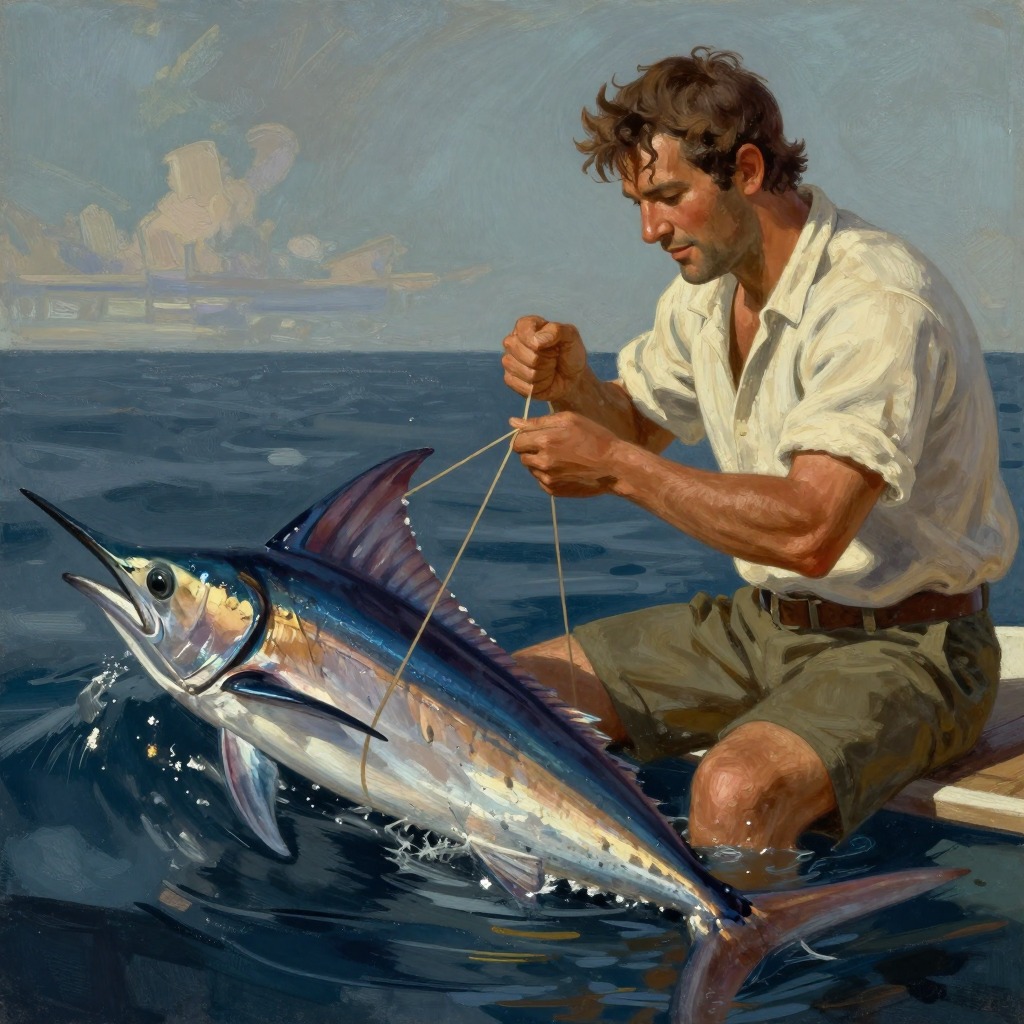
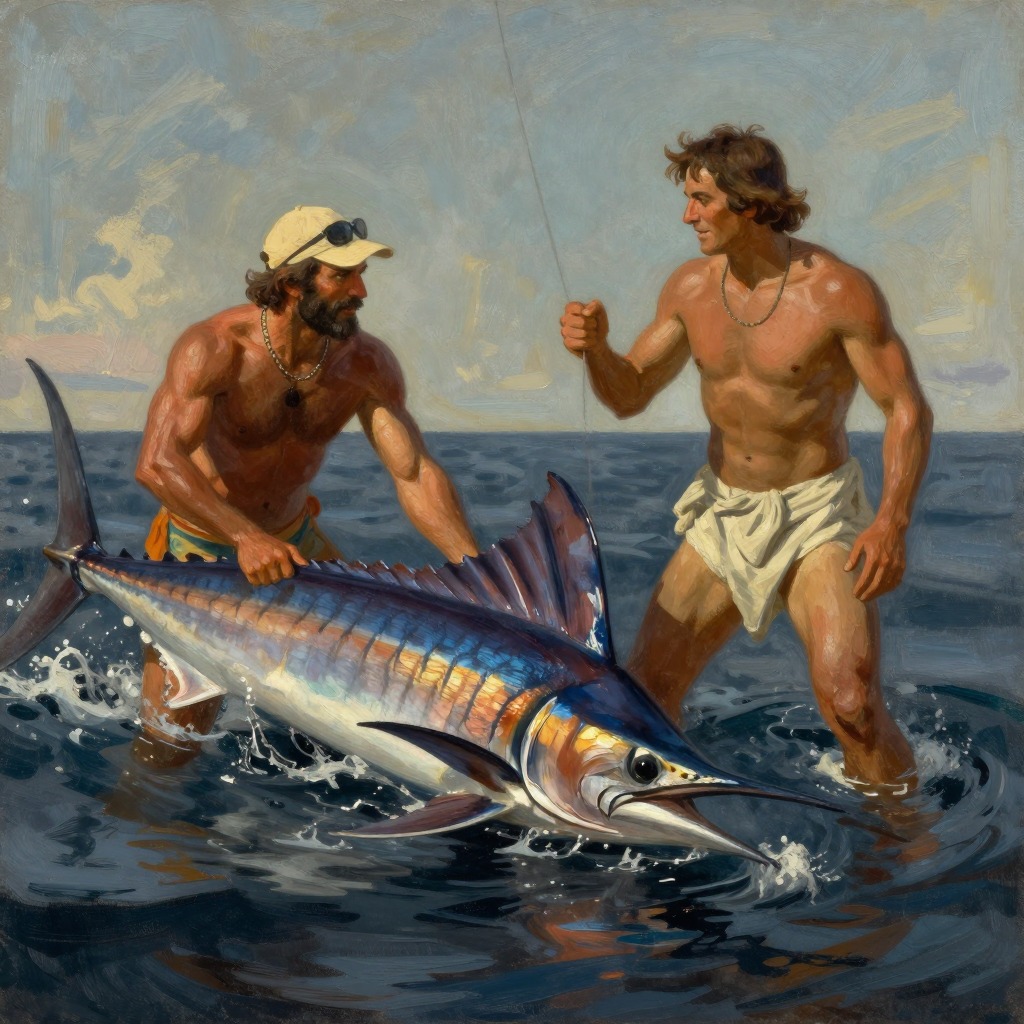
After several more turns, the marlin comes alongside the skiff. Santiago drops the line, puts his foot on it, and drives the harpoon into the fish's side behind the great pectoral fin. The fish leaps high out of the water, showing its full length and beauty, then crashes back into the sea. It floats belly-up, silver and still. The old man, faint and sick, lashes the fish to the skiff. He has killed his brother, and he feels a mix of triumph and sorrow.
Noon of the third day
Lashing the Marlin to the Skiff
Santiago ties the marlin alongside the skiff, passing ropes through its gills and mouth and around its tail. The fish is so large it seems like a second boat. He steps the mast, hoists the patched sail, and sets a course southwest toward home. He eats a few shrimps from Gulf weed and drinks some water. The skiff sails well, and the old man feels a sense of accomplishment despite his exhaustion.
Early afternoon of the third day
The First Mako Shark Attack
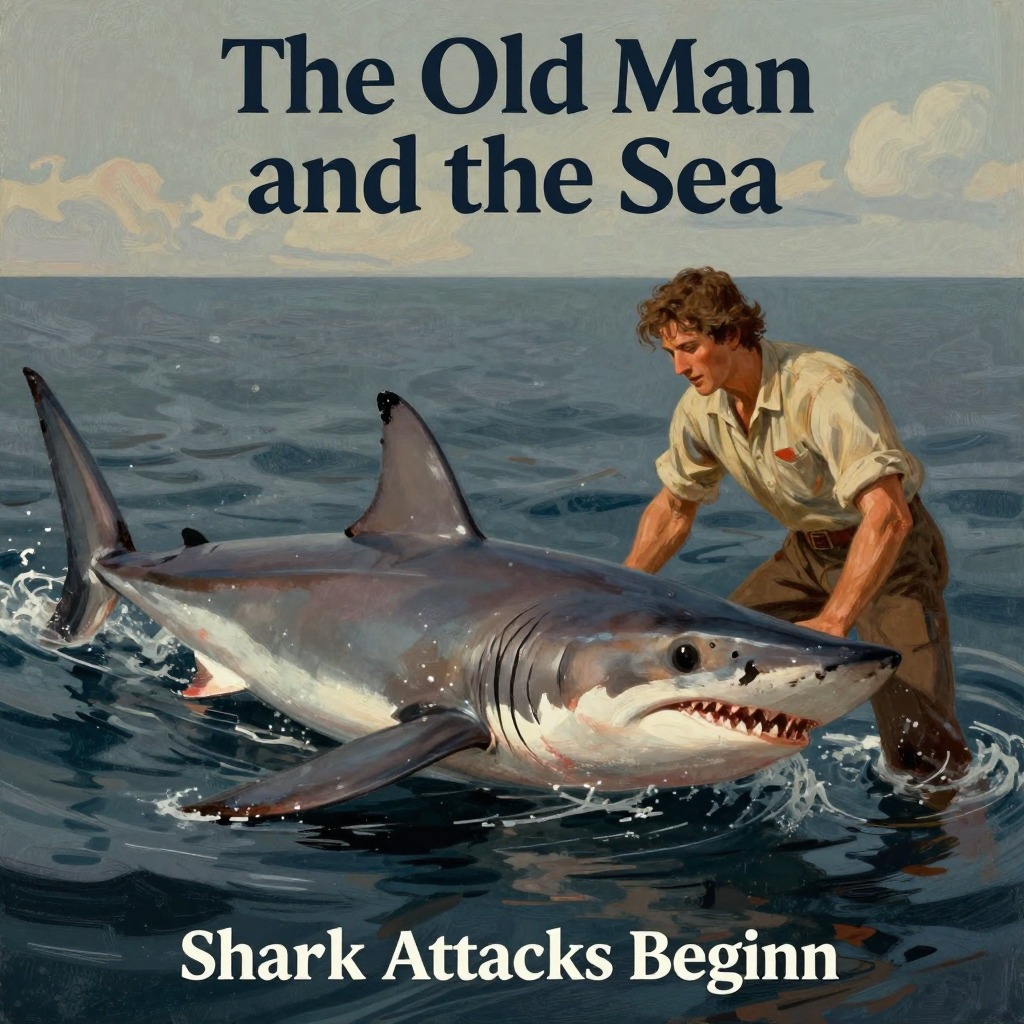
An hour after setting sail, a huge Mako shark arrives, drawn by the blood of the marlin. Santiago sees its blue dorsal fin and prepares his harpoon. The shark hits the marlin just above the tail, and Santiago drives the harpoon into its brain. The shark dies but takes the harpoon and rope with it as it sinks. The old man estimates the shark took about forty pounds of meat. He knows more sharks will come.
Afternoon of the third day
Reflections on Defeat and Sin
Santiago reflects on the shark attack and the coming struggle. He tells himself that a man can be destroyed but not defeated. He thinks about sin, wondering if it was a sin to kill the fish, but concludes that he was born to be a fisherman. He lashes his knife to an oar to create a weapon. The old man's thoughts reveal his philosophical nature and his acceptance of the harsh realities of life at sea.
Late afternoon of the third day
The First Galanos Attack
Two shovel-nosed sharks, galanos, appear. Santiago fights them with the knife lashed to an oar. He kills one by stabbing it in the brain and the other by driving the blade into its eye and severing its cartilage. The sharks take a quarter of the marlin's best meat. The old man is exhausted and his hands are badly cut. He apologizes to the fish for going out too far.
Late afternoon of the third day
The Single Shovel-Nose Shark Attack
A single shovel-nose shark attacks. Santiago drives the knife into its brain, but the shark jerks backward and the knife blade snaps. The old man is now without a knife. He has only the gaff, two oars, the tiller, and a short club. He feels beaten but resolves to fight as long as he can. He soaks his hands in the water and waits for the next attack.
Just before sunset of the third day
The Second Galanos Attack
Two more galanos arrive. Santiago fights them with the short club, hitting them on the head and nose. He manages to drive them away, but they have taken more meat. Half of the marlin is now destroyed. The old man is in great pain and knows he cannot last much longer. He steers toward the glow of Havana, hoping to reach shore before more sharks come.
Midnight of the third day
The Midnight Shark Pack Attack
A pack of sharks attacks in the dark. Santiago fights with the club until it is taken, then with the tiller until it breaks, and finally with the splintered butt. He stabs one shark in the head, and it rolls away. The sharks have eaten almost everything except the head, the backbone, and the tail. The old man is beaten, but he has fought to the end. He steers homeward, numb and exhausted.
Early morning of the fourth day
Return to the Harbor
Santiago sails into the little harbor before dawn. The lights of the Terrace are out. He beaches the skiff, unsteps the mast, and furles the sail. He sees the great tail of the marlin skeleton standing up behind the stern. He shoulders the mast and climbs the road to his shack, falling five times from exhaustion. He lies down on his bed, face down, and falls into a deep sleep.
Morning of the fourth day
The Boy Finds Santiago
Manolin comes to the shack and finds Santiago sleeping. He sees the old man's cut hands and begins to cry. He goes to get coffee, and on the way, he sees fishermen gathered around the skiff, measuring the skeleton at eighteen feet. The boy tells them not to disturb Santiago. He returns with hot coffee and sits by the old man until he wakes.
Late morning of the fourth day
Santiago Wakes and Talks with Manolin
Santiago wakes and drinks the coffee. He tells the boy, 'They beat me, Manolin. They truly beat me.' The boy insists the fish did not beat him, only the sharks. They make plans to fish together again. Santiago asks about the head and the spear, and the boy promises to get a new knife and a killing lance. The old man says he went out too far. The boy cries again as he leaves to get food and medicine.
Afternoon of the fourth day
The Tourists and the Skeleton
A party of tourists at the Terrace sees the marlin skeleton in the water. A woman mistakes it for a shark and comments on the beauty of its tail. The waiter tries to explain, but the tourists do not understand. The skeleton, now just garbage, will be carried out by the tide. This scene underscores the indifference of the world to Santiago's epic struggle.
Afternoon of the fourth day
Santiago Dreams of Lions
In his shack, Santiago sleeps again, face down, with the boy watching over him. He dreams of the lions on the beach in Africa. The dream symbolizes his enduring spirit and the cyclical nature of life. The story ends with this image of peace and continuity, suggesting that despite his physical defeat, Santiago's inner strength remains unbroken.